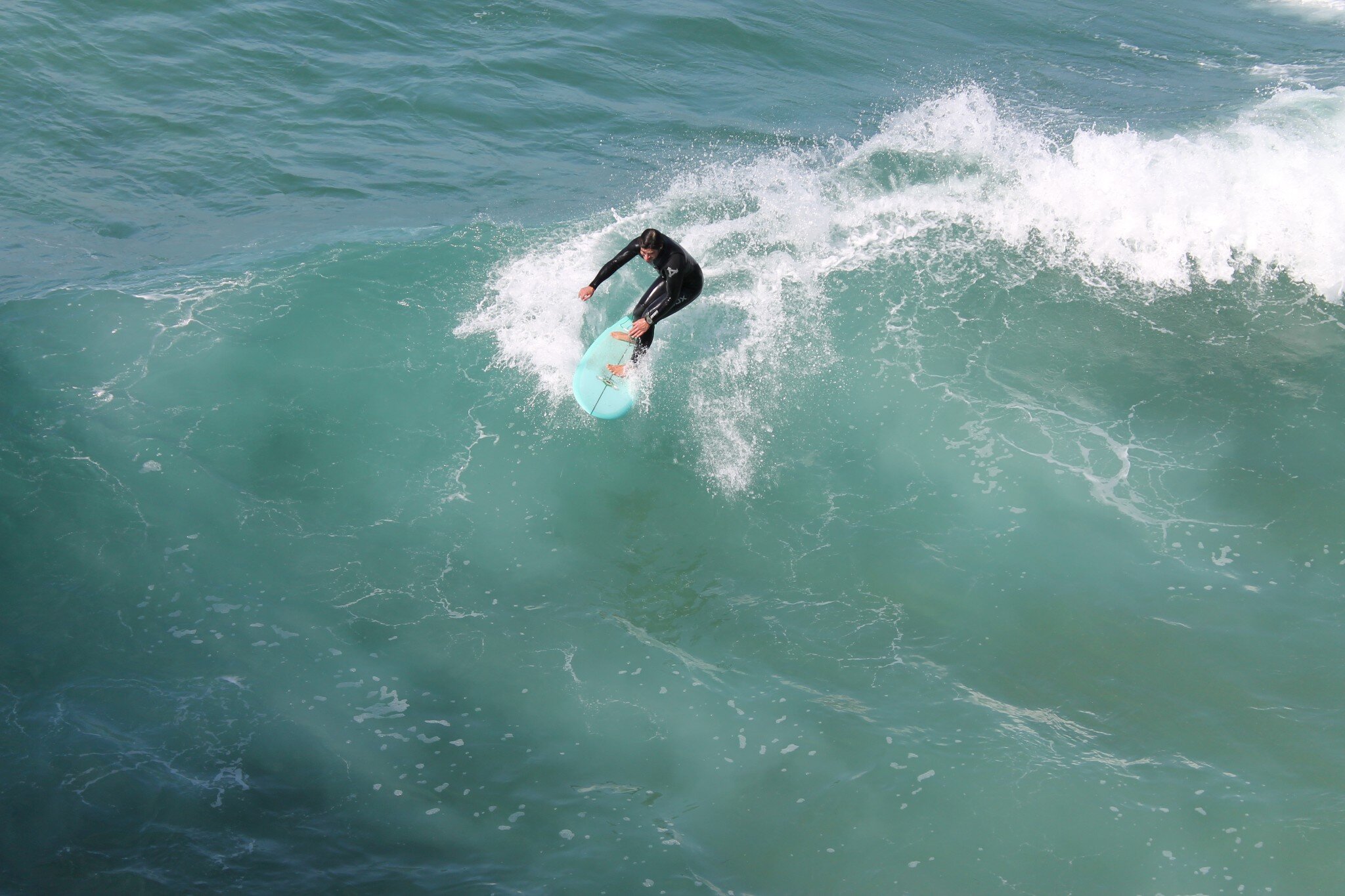
It’s hard not to note that this kind of attraction would never have taken root in the surfing-stubborn nineties, where conformity dictated that everyone at the beach rode three-finned shortboards.
At the tail-end of last year, the phenomenon of the Alaia appeared in the New York Times and it started me thinking about this tiny corner of the world of surf culture.
Alaias are virtually flat (finless!) pieces of wood that have been spotted in Australia and the US. Featurewise, they’re hard to paddle, hard to ride, and reportedly zippy down the line of pocket-ample waves. Without fins locking them in place, they also spin around waves like the arm on a cotton candy machine.
In the surfing world they’re an oddity, but they’ve been given credence by their provenance (the word and the board style are linked to the origins of surfing in Hawai’i) and also by some respectable shapers and pro-surfers who have taken on their mantle.
Still, it’s hard not to note that this kind of attraction would never have taken root in the surfing-stubborn nineties, where conformity dictated that everyone at the beach rode three-finned shortboards. Therefore, the room surfing has made for the alaia phenomenon reflects not only on the state of surfing as a whole, but on the state of our consumer culture.
First of all, those who wish to ride alais are, in fact, encouraged to build them themselves. Tom Wegener, the guru of the alaia phenomenon, sells a kit to those interested.
Further, alias are interesting by virtue of what they’re made out of: wood. This gets to a neurosis within surfing that has been building for about ten years, a neurosis given greater urgency by the shuttering of Clark Foam in 2005: surfing is very toxic, and this doesn’t jibe with the friend-to-the-ocean attitude most surfers adopt.
Of course, Clark Foam offered the predictability and uniformity of mass production, both features demanded by surfboard shapers who wanted to begin each of their boards with a well-known starting point. Beyond that, Clark and the broader surfing industry turned board building into a mass produced empire, and this trait also contrasted sharply with an old paradigm in surfing, the surfboard as work of art
Indeed, surfing has always relied on certain quasi-religious undertones perhaps because they’re easy to fall back on in the face of the unpredictability of the ocean. This surfing mysticism imparts meaning not only to the ocean but also to the mechanism by which we build our relationship with the sea, our surfboards, and this is perhaps where the surfboard as objet d’art originates from.

Thus, the idea of returning to wood to ride waves appeals to many who are made uncomfortable by the plastic goods surfers have ridden for the last 50 years, and the self-made aspect of the alaia has become an attempt to take back the entirety of the surfing experience. “Build it and ride it yourself,” devotees encourage the aspirants.
Of course, these attitudes aren’t new even if they are marked in the world of surfing. This trend toward making-it-yourself is part of a broader consumer backlash movement that has always been part of environmentalism. Ultimately, this movement is interested in answering the question: Where do our products really come from and how does our consumption implicate us in the history of these products?
With environmental issues gaining in urgency, this question has arrived in new and interesting ways. An ambitious new project called sourcemap.org, for instance, has started building maps that reveal not only the history of a product, but also its environmental impact. It’s no coincidence, for example, that the Patagonia Surf Shop sells Alaias and offers shoppers similar software that reveals the source of all Patagonia products.
What can be learned from the ways in which surfing has taken up this discussion? In a way, one lesson we consumers have imbibed for years has transformed itself: mass production makes things convenient for consumers, but it also makes them inherently meaningless. Anything that can be infinitely reproduced (as has been noted here before) is worthless, in the sense of imbued meaning. This result comes out of our expectation that only unique objects have inherent meaning and by inverse relationship anything that comes out of a factory does not. An alaia made in someone’s garage with old tools, for instance, is something that is bound to be loaded with meaning.
For a long time surfing was simply about consumption, a narcissistic pursuit of pleasure and small-minded glory. Now, surfing feels relevant again, threatening to boil over with discussions that affect people who don’t live on the coasts: where should our products come from? Can we make things without unmaking our world?
(For more on surfboard-making, check out Swaylocks.com, one of the coolest sites in the universe.)
No related posts.
Related posts brought to you by Yet Another Related Posts Plugin.